🏢 Buyer’s Journey: RFP Stages
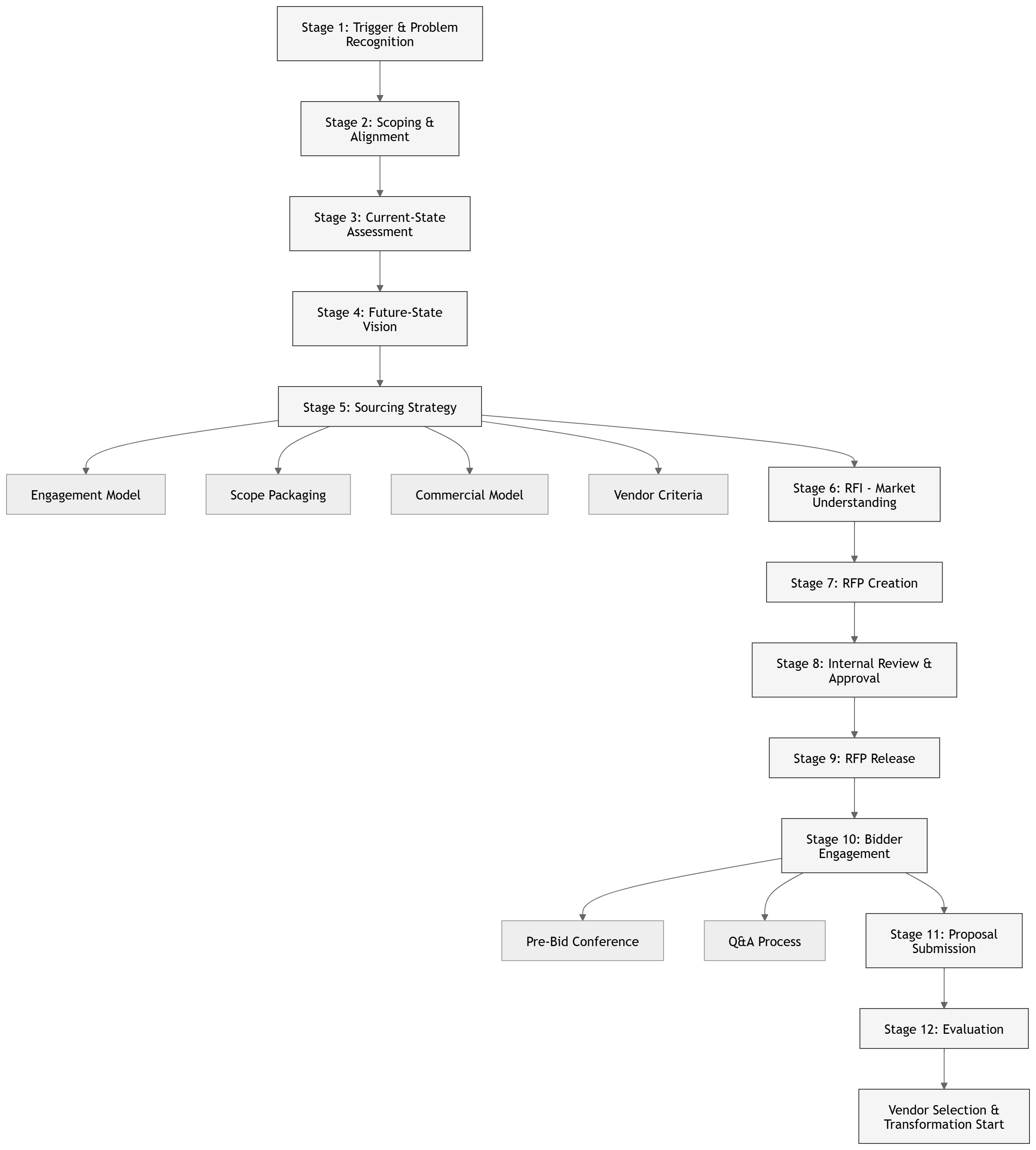
This section covers the key stages an enterprise typically goes through before, during, and after an RFP. The stages may expand or collapse depending on the scale, complexity, urgency, and governance model of the sourcing initiative.
The goal is simple: to provide a structured, end-to-end view of how a business need becomes a formal sourcing decision.
The diagram below provides a high-level view of how an enterprise RFP lifecycle typically flows—from initial problem recognition to final vendor evaluation. It primarily focuses on the typical flow at the customer’s side.
🎯 The Real Purpose of the RFP Process
An RFP is a formal document that an organization sends to selected vendors asking them to propose a solution for a business problem. But in practice, it is more than that. The RFP is a structured process for turning a messy business problem into a clear market ask.
Most think an RFP starts when the document is sent to vendors. In reality, that’s already too late. The success or failure of an RFP is decided much earlier—when the problem is first recognized and defined.
🧭 Explore this Series
I will break this into stages. For each stage, I will cover:
- What the stage is for
- Who is involved on the customer side
- Who may be involved on the service provider side
- What gets produced
- What can go wrong if this stage is poorly done
Let’s Begin!
| Stage | Link |
|---|---|
| Stage 1: Trigger & Problem Recognition | Open |
| Stage 2: Scoping & Alignment | Open |
| Stage 3: Current-State Assessment | Open |
| Stage 4: Future-State Vision | Open |
| Stage 5: Sourcing Strategy | Open |
| Stage 6: RFI | Open |
| Stage 7: RFP | Open |
| Stage 8: RFP Approval & Release | Open |
| Stage 9: Bidder Engagement, Proposal & Evaluation | Open |